
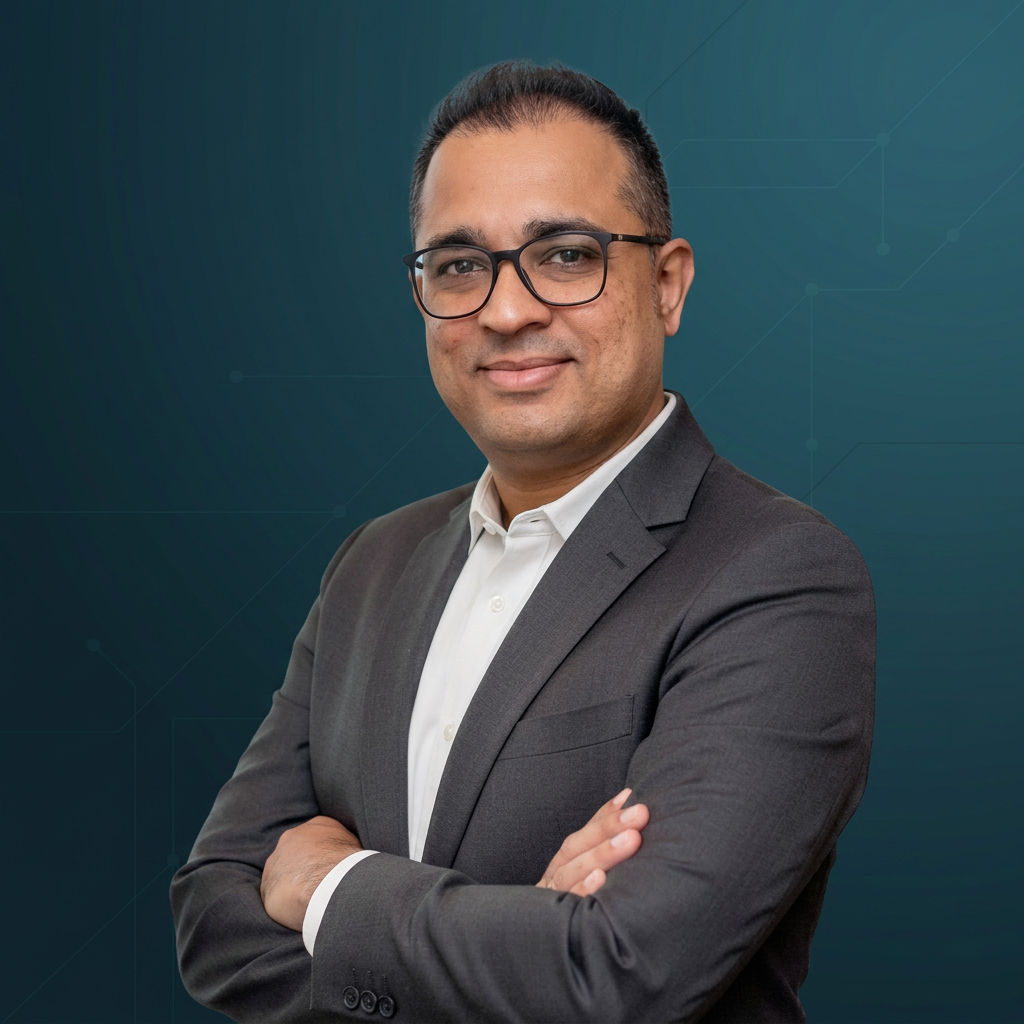
Author & Founder

Dr. Rahul Dev

PhD data scientist, technology patent attorney, researcher, inventor and founder behind AIDataCenterHQ's research-led AI infrastructure platform.

Save or follow this source
Dr. Rahul Dev, founder and author of AIDataCenterHQ
Customized consultation

Work directly with the platform author on an AI-infrastructure strategy

Discuss AI infrastructure, technology commercialization, market intelligence or growth strategy with Dr. Rahul Dev.

Discuss this with Dr. Rahul Dev
Professional profile

AI, infrastructure, intellectual property and business strategy

Dr. Rahul Dev is a PhD data scientist and technology patent attorney with 20+ years of experience across AI, infrastructure, emerging technology, intellectual property, research and business strategy.

Role at AIDataCenterHQ

Dr. Rahul Dev is the founder, author and research lead behind AIDataCenterHQ. His role spans the platform's research direction, AI infrastructure analysis, original Research & IP work and the development of decision-oriented intelligence across data centers, GPU infrastructure, cooling, power, markets and economics.

AIDataCenterHQ deliberately separates third-party Directory & Intelligence from proprietary Research & IP. That separation allows industry coverage to remain distinct from original invention and research work.

Areas of expertise

  • AI infrastructure and AI data centers
  • GPU and compute infrastructure
  • Cooling, power and high-density facility systems
  • Data-center economics and commercial strategy
  • Technology commercialization and intellectual property
  • Patent strategy, AI and data science
  • Technology and business research

Research and intellectual-property work

The AIDataCenterHQ Research section presents original AI-infrastructure research and invention work at an illustrative public level. Full enabling detail is not published automatically and may require counterparty verification, an NDA and legal review before deeper disclosure.

Related professional work in technology patents can also be explored through Patent Business Lawyer, while broader intellectual-property research work is represented through GIP Research.

Technology law and corporate legal intelligence

Dr. Rahul Dev's professional work also extends into technology-law and corporate-legal contexts. Relevant external resources include TechLaw.Attorney for technology-law work and TechCorpLegal for technology and corporate legal intelligence.

Editorial and research approach

AIDataCenterHQ is built around evidence-led research, source transparency, verification dates for changing claims, and separation between facts, analysis and sponsored material. Market estimates should disclose definitions, pricing should carry units and timestamps, and rankings should only be used where the methodology and underlying data can be explained.

Original research is presented with an equally clear disclosure boundary. Modeled, benchmarked, prototype and deployed evidence should be described according to what has actually been demonstrated.

Current focus at AIDataCenterHQ

The current platform focus includes AI data-center intelligence, GPU-cloud economics, cooling and power infrastructure, market and investment intelligence, decision tools, structured data, and original infrastructure research.

Professional profiles and contact

Frequently Asked Questions

Who is Dr. Rahul Dev?

Dr. Rahul Dev is a PhD data scientist, technology patent attorney, researcher and founder of AIDataCenterHQ.

What is his role at AIDataCenterHQ?

He leads the platform's research direction, authors technical analysis and develops original AI-infrastructure research and IP.

What topics does he research?

Primary areas include AI infrastructure, data centers, GPU compute, cooling, power, technology commercialization, intellectual property and business strategy.

How can professional or research enquiries be submitted?

Use the AIDataCenterHQ Contact page or the approved professional profile links above.

Customized consultation

Bring a specific infrastructure or growth challenge

Frame a customized consultation around your technical, market or commercial outcome.

Discuss the next decision

Discuss AI infrastructure, research or commercial opportunities

Use the official contact page for professional, research, technology or qualified IP enquiries.

Research approach

How domain, technology and commercial analysis are combined for AI infrastructure decisions

AI infrastructure sits at the intersection of engineering constraints, technology change, market structure and commercial strategy. Useful analysis therefore requires more than familiarity with data-center terminology. It requires a method for connecting technical specifications to business outcomes while keeping evidence, assumptions and interpretation separate. The author framework used on AIDataCenterHQ starts with the decision a user needs to make and then traces the entities, relationships, evidence and limitations required to answer it.

A GPU cloud comparison illustrates the approach. A quoted price per accelerator-hour is not enough to compare two offers if the underlying accelerator variant, memory, host configuration, NVLink or NVSwitch topology, scale-out network, storage, region and commitment terms are different. The analysis therefore normalizes the configuration before interpreting the price. The same principle applies to data-center capacity, where operational megawatts, contracted power, available capacity and announced pipeline should not be treated as interchangeable.

Technical architecture must connect to facility architecture

Accelerated computing changes facility requirements through concentration. Higher compute density can raise rack-level electrical demand and heat rejection requirements, while large training clusters increase sensitivity to network topology and power continuity. Public manufacturer reference architectures help establish the technical relationships, but the facility implication still depends on deployment design. The author approach therefore connects accelerator, network and storage choices to power and cooling questions rather than treating technology selection as a standalone hardware exercise.

Market research needs definitional discipline

Market forecasts are useful only after the measured market is identified. Revenue, installed capacity, construction pipeline, capital investment and electricity demand answer different questions. Two reputable sources can publish different growth rates without either being wrong if their definitions, base years or geographic boundaries differ. AIDataCenterHQ research therefore emphasizes the definition, date, scope and methodology behind headline market numbers and uses cross-source synthesis when the differences themselves are decision-relevant.

Evidence strength should match claim strength

Consequential statements should be supported by the strongest reasonably available evidence. Official energy data, regulatory documents, standards, peer-reviewed work, corporate filings and manufacturer specifications normally carry more evidentiary weight than generic summaries. That does not make primary sources infallible: company disclosures may describe announced plans rather than delivered capacity, and technical documentation may describe a reference configuration rather than actual customer performance. The research task is to state what the source establishes and what still requires interpretation.

Patent and innovation analysis adds a different lens

Technology innovation can be studied not only through products and markets but also through patents, standards, research literature and technical constraints. Patent documents can reveal problem framing, system relationships and possible design approaches, but they should not be treated as proof that a mechanism is deployed commercially or that a claimed advantage has been achieved. This distinction is important in the Research & IP section, where public material should separate conceptual mechanisms, modeled outcomes, benchmarks, prototypes and deployed evidence.

Commercial strategy should be tied to measurable outcomes

Companies engaging with AI infrastructure may be trying to reduce compute cost, secure capacity, enter a geography, improve facility efficiency, launch an infrastructure product, monetize data, build a directory or intelligence platform, or create a new revenue channel. The analysis should therefore connect the technical issue to the commercial objective. A better PUE number is useful only if the facility and workload context make it meaningful; a lower GPU price is useful only if the configuration and utilization support the workload; a market-growth forecast is useful only if the company can access the market and differentiate its offer.

Scenario thinking is preferable to false precision

AI infrastructure decisions often contain uncertainty around utilization, energy price, hardware availability, customer demand and deployment schedule. A single-point forecast can hide that uncertainty. Scenario analysis makes assumptions visible and lets decision-makers test what happens when a key variable changes. Tools such as ROI calculators and pricing comparators are most useful when their assumptions can be inspected and changed rather than when they present one output as a prediction.

Public research and customized consultation serve different purposes

Public pages are designed to answer recurring user needs with transparent evidence and broadly applicable methods. A customized consultation can go further because it can use the actual workload, company strategy, geography, constraints and private inputs of the client. The public research should therefore remain useful without requiring a sales conversation, while the consultation path exists for users who need to translate the research into a decision specific to their organization.

Readers should independently validate material used for engineering, investment, legal, regulatory or financial decisions. The author and publisher information is provided so that the provenance of the analysis is clear and so that users can ask project-specific questions where the public material cannot resolve a particular constraint or objective.

Continue through the connected research

Move between the parent section, related child pages and adjacent AI-infrastructure topics without losing the decision context.

Customized consultation

Need a dr. rahul dev strategy built around your constraints?

Contact Dr. Rahul Dev to translate this page into a customized consultation focused on your workload, geography, timeline and commercial outcome.

Contact Dr. Rahul Dev

Readers examining Dr. Rahul Dev may also need adjacent material on technology law, patent strategy, research publication, international protection, or corporate legal issues. The following external resources cover those adjacent subjects; inclusion here does not imply third-party endorsement of the factual analysis on this page.